
Becoming a Sangoma, a South African traditional healer.
Camagu.
My journey to becoming a Sangoma was totally unexpected, and not at all what I imagined my life becoming.
Back in 2009, I travelled to South Africa for a job doing hair and make-up on an HBO production. Before arriving there, we had been filming in Prague during winter, where the lead actor slipped on ice and broke a bone in his foot, if my memory serves me right. Production shut down for a six-week hiatus, and the crew were given the option to fly home, remain in the hotels, or do as we wished.
I decided to travel along the Garden Route.
None of the other make-up artists wanted to come, so I put all my belongings into the hotel luggage hold and packed a small rucksack, thinking I would only go away for a couple of weeks. I travelled between backpacker hostels using something called the Baz Bus, a hop-on, hop-off bus for travellers. It was incredibly easy and the adventures felt endless.
I had never travelled alone before, so this way of travelling felt safe and freeing. Along the way, I met a couple of guys around my age who were travelling to Port St Johns, a small town outside Lusikisiki, and they invited me to join them.
At first, I was hesitant.
I spoke to a Spanish girl who had been travelling with them and she reassured me they were trustworthy. The boys explained they were going to meet a friend named Chris Mhlophe, short for Ntombemhlophe, who was a traditional healer, a Sangoma.
At the time, I had absolutely no idea what that meant.
They convinced me to leave the Baz Bus behind and travel by local taxi instead. This was where my real African experience began. The local taxis were unlike anything I had ever seen before. Tiny minibuses crammed full of people, shopping tied to the roof, live chickens squeezed in amongst the passengers, dusty roads, noise, colour, movement everywhere. It was total sensory overload.
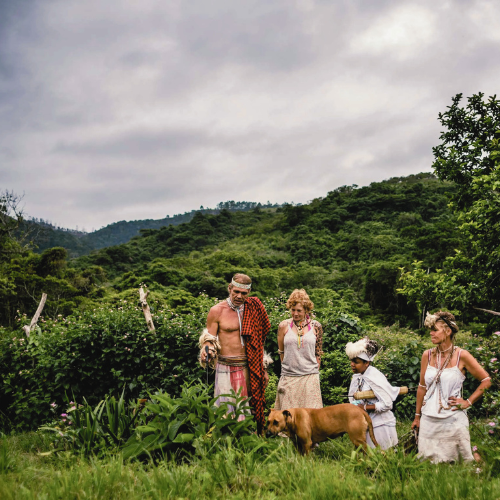
When we arrived at Amapondo Backpackers, we were greeted by what I can only describe as a mystical creature.
A tall, slender man with flowing blonde hair, dressed in a brightly coloured skirt and adorned with beautiful beads and animal skins wrapped around every limb possible. There was a slight smell of goat, I have to admit. His face was tattooed, and he carried the biggest, warmest smile and the most incredible energy.
The feeling I had meeting him was impossible to explain. It was like returning home whilst simultaneously fearing the unknown.
We spent a few days at the backpackers, visiting the beach, walking to the swing, heading into town, and occasionally seeing Ntombemhlophe. Eventually, he invited us to his homestead.
I really didn’t want to go.
It felt too unfamiliar and completely out of my depth. I even joked that he was going to put us in a pot and cook us like an old-fashioned movie. Thankfully, the boys persuaded me.
The night before we travelled there, I had a dream.
In the dream, Ntombemhlophe held out his hand. In his palm sat a red seed surrounded by white beads. I was frightened, but I accepted them. The next day, I innocently told him about the dream.
He smiled and simply said, “Come. You must come visit my homestead.”
Much later, I realised this was the beginning of my calling.
We travelled to the homestead by two local taxis before walking deep into the valley, down rocky mountain paths, through forests and fields, crossing rivers until we reached the very bottom.
Back then, the homestead consisted of three round huts, known as rondavels, and one square hut. There was the kitchen hut, the sacred hut called the Makhosini, the ceremonial hut, and a guest hut.
There was no electricity. No running water.
It was truly a “chop wood, carry water” lifestyle.
During this time, my dreams intensified. I dreamt of washing clothes and dishes whilst people ignored me. The clothing was always white. Later, I learned these were symbolic dreams connected to Sangoma training. White is worn during the early phases of ukuthwasa, and during this period people often do not acknowledge you.
Eventually, I returned to five-star hotels, film sets and normal working life.
But something had shifted.
Over the next three years, my life spiralled downward. Work became increasingly difficult, friendships exhausted me, and I searched desperately for answers. I tried therapy, yoga, even travelling to India and staying in ashrams.
These
I would dream of being lost in forests, hearing drums, seeing leopards, and Ntombemhlophe always finding me. Sometimes I would wake up still hearing the drums, only to realise there was nobody outside my West London window.
Eventually, I contacted him.
He told me I had the calling to ukuthwasa, to train as a Sangoma.
Honestly, I thought it was complete rubbish.
I truly believed it was some kind of scam.
But as the years passed, things worsened. At times I could barely hear people speaking to me, as though I was disconnected from the world around me. Eventually, I reached a point where I felt I had nothing left to lose.
So I returned to South Africa.
I was initiated by Ntombemhlophe Reid into the Dlamini lineage within the mPondo tradition. His homestead is situated beneath the hills of Gwenxintaba in Lusikisiki, deep within the valley of Mdekane Gxeni.
I spent four years training there.
Ukuthwasa is a path of humility, discipline and deep ancestral connection. You are stripped back entirely. You connect with ancestral medicines, rituals and ceremonies. You are given a new name. My name became Tyatyambo, which translates directly to “flower”, though spiritually it means “the flower of the ancestors, the one who blossoms.”
You carry two sticks everywhere you go, your antennas to the ancestors. White clay is painted onto your skin and you become invisible, spirit-like.
Beds and chairs become forbidden.
The pain of sleeping on thin mats and sitting constantly on hard floors was unbearable at first. My feet blistered constantly. Shoes were forbidden. Silence was enforced.
Sex was forbidden.
The diet was strict. No dairy. Only white meat from chicken breast was allowed. Herbal medicines were used to purge and cleanse energy from the body.
Everything had purpose.
The first phase of training is known as “being in white.” During this stage, you speak only when spoken to. You kneel when entering doorways and carry water and wood before sunrise. The purpose is humility, cleansing and learning to hear your ancestors within silence.
The second phase is “turning red.”
This phase comes after earning your goat through dream tasks and proving your connection to your ancestors. Red symbolises blood, life and grounding. You begin learning medicines from the forest and how to work with spirit more deeply.
The training was gruelling.
But amongst the strictness there was also joy. We laughed often. One punishment for waking up late was chilli in our tea, though secretly we loved it and pretended otherwise so we’d get more.
My favourite moments were early mornings before sunrise, sitting quietly in the kitchen after herbal steam baths, listening to Tata tell stories while chickens wandered around laying eggs.
Eventually came the final phase, becoming a Sangoma.
You spend a night alone in the forest with your ancestors. You collect sacred plants, paint your body with clay, and return at sunrise to begin the ceremonies.
It is like a wedding to your ancestors.
The community gathers from miles around. There is singing, dancing, food, trance and celebration. The energy created through the ancestors, the Amathongo, is unlike anything I can describe.
Pure. Wild. Beautiful.
Each stage of initiation is deeply personal, and there are sacred elements I will never share publicly. But what I can say is this:
Spirit is real.
As Ntombemhlophe once said: “Spirit has no culture, no colour and no religion. Spirit is spirit.”
I truly believe my ancestors led me to my mentor through dreams and through the sickness of the calling, and that the process of ukuthwasa ultimately healed me. His loss devastated all of us. His spirit family, his blood family, and the countless people whose lives he touched felt the emptiness left behind.
He is now spirit.
He is Amathongo.
My spirit father.
As his children, we honour him by continuing his work and keeping his memory alive.